
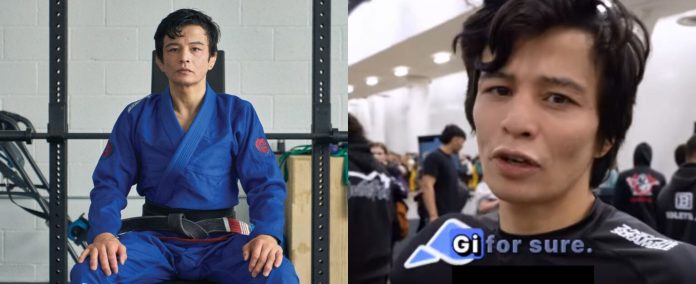
Accomplished black belt Joao Miyao has made his preference clear in the ongoing debate between gi and nogi Brazilian Jiu-Jitsu. The veteran competitor recently explained why he gravitates toward training with the traditional uniform rather than without it.
“Gi, for sure,” Miyao stated in a recent interview when asked about his preference between the two styles. His reasoning centers on the expanded technical possibilities that come with the gi. “I have more options. It’s more fun for me.”
Miyao’s perspective adds an interesting voice to a conversation that has been gaining momentum in the BJJ community. His position aligns with several other high-level athletes who have expressed similar views about the technical depth available in gi training.
Olympic wrestling champion Amit Elor, who holds a purple belt in Brazilian Jiu-Jitsu, shares this outlook. Despite her wrestling background, Elor has stated her preference for gi work.
“This is going to sound really weird coming from a wrestler, but gi,” she explained. “I like how you can do so much more technically with the gi versus no gi. I feel like it’s a little bit more limiting.”
The technical advantages of gi training stem from the additional grips and control points that the uniform provides. Practitioners can use the collar, sleeves, and pants to execute a wider variety of techniques, creating more pathways to submissions, sweeps, and positional control.
Miyao, whose favorite submission is the baratoplata, a shoulder lock that particularly benefits from gi grips, exemplifies this technical approach. The baratoplata requires precise control and manipulation of the opponent’s arm, often facilitated by collar and sleeve grips that are only available in gi training.
The conversation around gi versus nogi has intensified as nogi competition gains popularity in the grappling world. Some prominent figures have characterized nogi as a more streamlined version of the art.
Renowned American black belt Keenan Cornelius has previously described no-gi jiu-jitsu as a simplified version that requires far less mental effort.
While discussing his increased focus on no-gi training, Cornelius explained: “The way that the game has evolved is really amazing, and I’ve been enjoying it a lot,” before bluntly characterizing no-gi as “a simplified version of gi.”
He went on to emphasize the reduced cognitive demands of the style, stating, “It’s so simple. You actually have to underthink. You need to think less energy than you have to think in the gi, and that can be liberating.”
For Miyao, the choice is clear. After 16 years on the mat and reaching the highest belt rank, he continues to find more enjoyment and opportunity in the traditional format. When asked what lesson from jiu-jitsu he applies to everyday life, his answer was immediate: “Never give up.”
Following a recent gold medal performance, Miyao maintained a humble perspective on his success. “I think I’m better today, but next competition my opponent can be better than me,” he noted.