

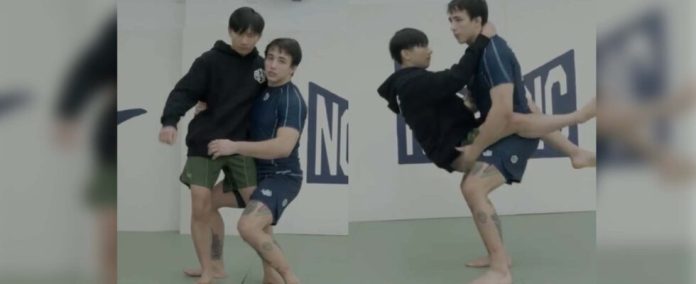
The first banned technique at Chen‘s facility is the flying scissor takedown, known in judo as Kani Basami. This movement involves jumping with full body weight into an opponent’s legs.
“When done properly, it’s safe. However, the way this would go wrong is essentially I go into Lin and this hyper extends his knee and it’s all of my body weight going into his knee slash shin. This can actually result in a lot of catastrophic injuries.”
The prohibition extends to jumping closed guard, another movement that seems controlled under ideal circumstances but becomes dangerous in live training. Chen explains that while an instructor prepared for the movement can safely catch a jumping partner, unexpected situations create serious risk.
“If let’s say my legs are extended, Lin’s a little bit far, he jumps, this can result in some catastrophic injuries.”
The common thread connecting these banned techniques is uncontrolled body weight impacting joints that cannot withstand lateral or unexpected forces.
The second major category of prohibited movements involves sitting into the side of a training partner’s knee. This typically occurs during takedown attempts when practitioners sit back while controlling their opponent.
“A very common judo move is Tani Otoshi where you’re looking to block the far leg and you’re sitting into the side of the knee.”
While the technique can be executed safely in competition by experienced grapplers, the margin for error in daily training proves too narrow.
“The risk for injury is quite high.”
Beyond these specific bans, Chen‘s academy maintains broader safety protocols around controlled execution of all submissions and takedowns. When performing techniques that involve lifting opponents, Chen stresses the lifter’s responsibility for their partner’s wellbeing.
“I don’t want to just drop by completely dropping to the ground. We want to look to at least give our partners some time to fall.”
He adds an important detail about maintaining posting ability during throws.
“Why do we mat return up on there? Let’s say I’m mat returning Lin to his left. You don’t want to trap his arm because now look, when you can’t post, you can’t break this fall. I could possibly spike him. This is definitely something we’re looking to avoid.”
“We injure our training partners, we have no training partners.”
He encourages students to control submissions slowly, allowing time for opponents to recognize the position and tap.
“I much rather you guys have a submission, lose it because you gave them time to tap as opposed to injuring your partner.”
Chen currently teaches daytime open training sessions and classes, along with half the evening classes. His instruction occurs in both English and Mandarin, switching between languages based on the students present.