
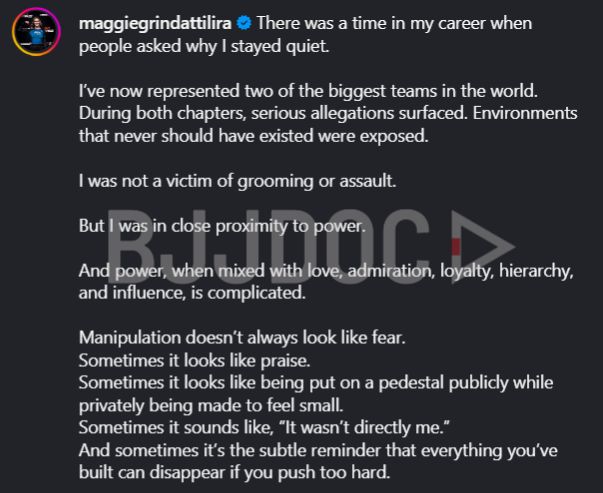
Maggie Grindatti Lira released a public statement addressing her past association with Roberto Cyborg Abreu. Her statement comes following serious allegations against Andre Galvao and Team Atos.
“There was a time in my career when people asked why I stayed quiet. I’ve now represented two of the biggest teams in the world. During both chapters, serious allegations surfaced. Environments that never should have existed were exposed.”
While Grindatti Lira clarified she was not personally subjected to abusive behavior, she described the complex dynamics that can silence those who witness problematic behavior within hierarchical training environments.
“I was in close proximity to power. And power, when mixed with love, admiration, loyalty, hierarchy, and influence, is complicated.”
Her statement arrives 5 years after The New York Times published an investigation in 2021 examining Roberto Cyborg Abreu‘s response to criminal charges against Marcel Gonçalves, a longtime student and black belt under Abreu.
Gonçalves was arrested in March 2018 at a Naples, Florida gym and charged with three counts of SA involving a 16-year-old female student who was also a close family acquaintance.
Abreu faced particular scrutiny for maintaining contact with Gonçalves after the arrest and for allowing him to appear at his BJJ gym in the days following the beginning of the investigation. The target began training with Gonçalves at approximately age 11 or 12. Goncalves escaped justice and returned to Brazil. There were rumors floating around for years that Cyborg helped Goncalves get out of the country.
Abreu publicly acknowledged making errors in how he responded to the allegations connected to his organization following the viral coverage.
Grindatti Lira’s statement speaks directly to the psychological mechanisms that can prevent people from coming forward, even when they witness concerning patterns.
“Manipulation doesn’t always look like fear. Sometimes it looks like praise. Sometimes it looks like being put on a pedestal publicly while privately being made to feel small. Sometimes it sounds like, ‘It wasn’t directly me.’ And sometimes it’s the subtle reminder that everything you’ve built can disappear if you push too hard.”
She described attempting to address concerns internally but encountering resistance.
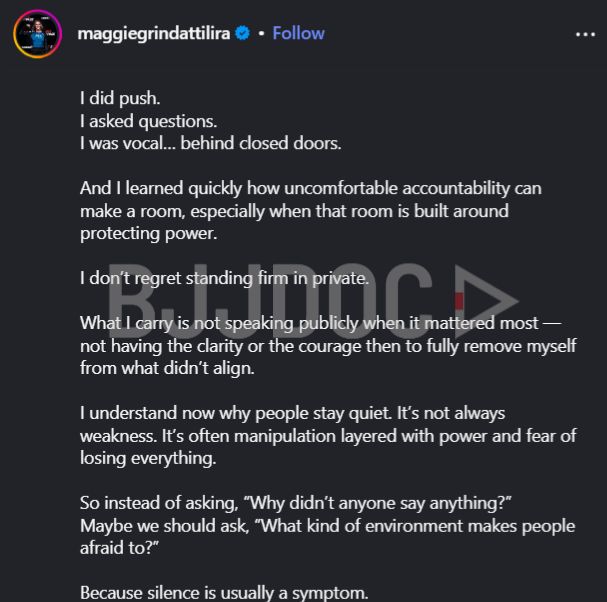
“I did push. I asked questions. I was vocal, behind closed doors. And I learned quickly how uncomfortable accountability can make a room, especially when that room is built around protecting power.”
“What I carry is not speaking publicly when it mattered most, not having the clarity or the courage then to fully remove myself from what didn’t align.”
The statement challenges the BJJ community to reconsider how it responds to those who remain silent in difficult situations.
“I understand now why people stay quiet. It’s not always weakness. It’s often manipulation layered with power and fear of losing everything.”
She reframed the conversation around accountability, suggesting the question shouldn’t focus on individual silence but rather on systemic conditions.
“So instead of asking, ‘Why didn’t anyone say anything?’ Maybe we should ask, ‘What kind of environment makes people afraid to?’ Because silence is usually a symptom.”
Grindatti Lira called for fundamental change in how the sport views authority figures.
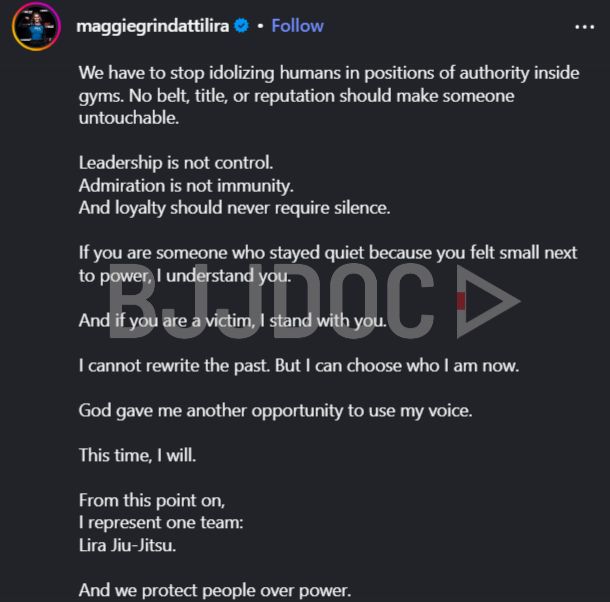
“We have to stop idolizing humans in positions of authority inside gyms. No belt, title, or reputation should make someone untouchable.”
She outlined clear principles that should guide leadership within martial arts spaces.
“Leadership is not control. Admiration is not immunity. And loyalty should never require silence.”
“If you are someone who stayed quiet because you felt small next to power, I understand you. And if you are a person harmed, I stand with you.”
Her full statement: