

Former WEC champion and UFC lightweight title challenger Hermes Franca has returned to teaching Brazilian jiu-jitsu in Brazil after serving time for SA of a minor in the United States.
The MMA History Podcast interviewed Franca and basically got the official confirmation as to what his current occupation is.
Franca’s journey in combat sports began in 1994 when he started training Brazilian jiu-jitsu at age 18 in Brazil. In 2000, Franca came to the United States on a tourist visa, initially working jobs like car washes and construction while training sporadically.
Franca was one of the foundational MMA stars at American Top Team:
“If the American Top Team is what it is right now, it’s because of Hermes Franca, because I did a lot.”
By the time he reached the UFC in April 2003, Franca was 7-0.
However, Franca’s career became increasingly complicated by personal issues. He claimed that the spotlight and lifestyle in Las Vegas led him down a destructive path.
“Back in the day was a lot of show, a lot of women, a lot of girls and I was like, man, I was going to the wrong path,” Franca explained. “I start to training but not training like before and I start to use a lot of ( ) and having like a wild life.”
Franca achieved victories over Spencer Fisher, Nate Diaz and Jamie Varner.
He challenged Sean Sherk for the UFC lightweight title at UFC 73 in 2007.
Franca was arrested for SA of a 14 year old in 2011. MMA promotion he was contracted with at the time promptly released him.
Franca was officially charged in May of 2011.

In a 2025 interview, Franca claimed that in 2011 he made a commitment that changed his trajectory.
“I wrote to God. I said, God, if I use these things again, you can finish my life.”
“That’s it,” he recalled.


Franca’s appearance on the IBJJF podium at the 2021 Sul Americano (officially listed as Male / Master 4 / Black / Medium-Heavy, representing Zero85 Jiu-Jitsu) sits uneasily beside the federation’s 2025 “Official Statement” declaring a long-standing, uncompromising policy of permanent removal, mandatory SafeSport certification, and rigorous background checks for black belts leading academies.
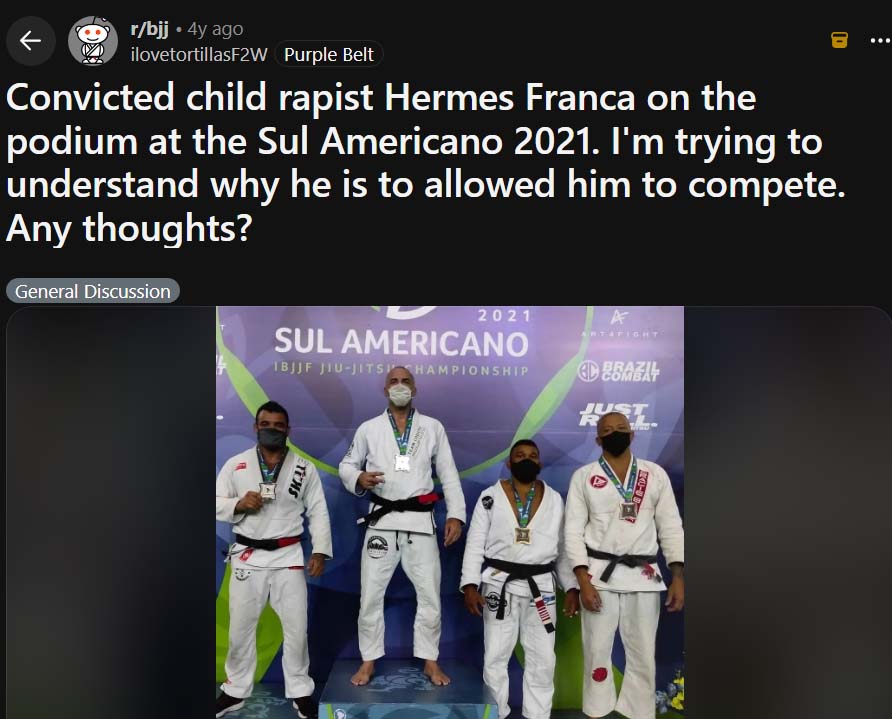
If those safeguards had truly been enforced “for several years,” as claimed, it is difficult to reconcile how a convicted individual was permitted to compete without public clarification.
Further, an investigation into Hermes Franca’s IBJJF competition record reveals he was competing at a number of Brazil set IBJJF competitions from 2019 until 2021 when this picture was made public.
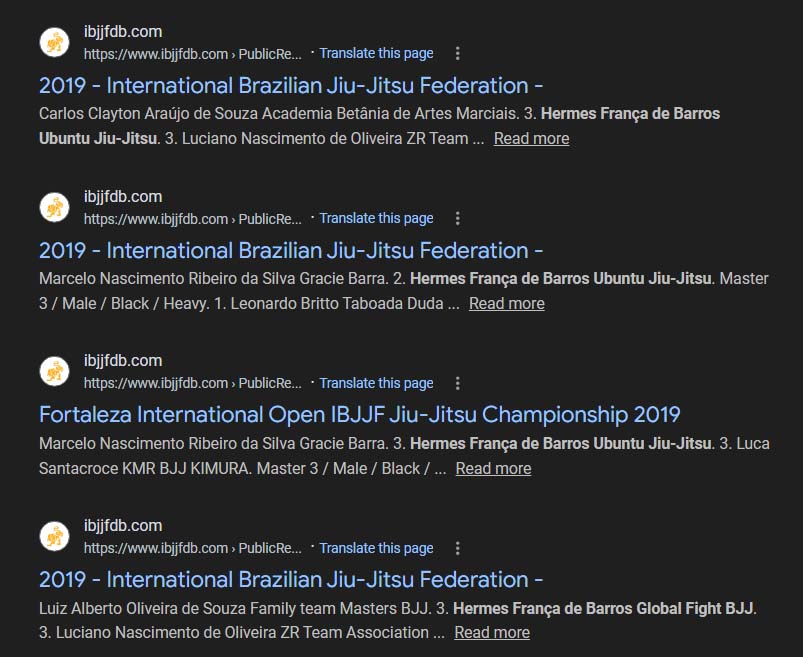

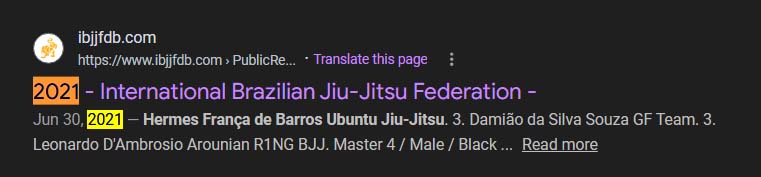
Franca was listed under three teams in the IBJJF system. Two of those schools no longer have any certified black belts on their site. It’s presumed Franca was suspended following public backlash. A statement was never released.
Today, Franca no longer appears on the IBJJF’s certified black belt list. Meanwhile, he has continued competing under the UAEJJF banner through the 2023–2024 season, where membership terms contain no prohibition tied to criminal history.
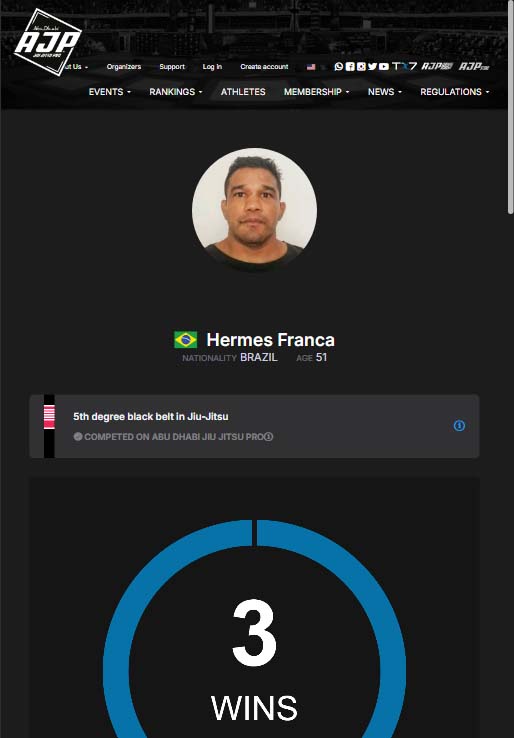
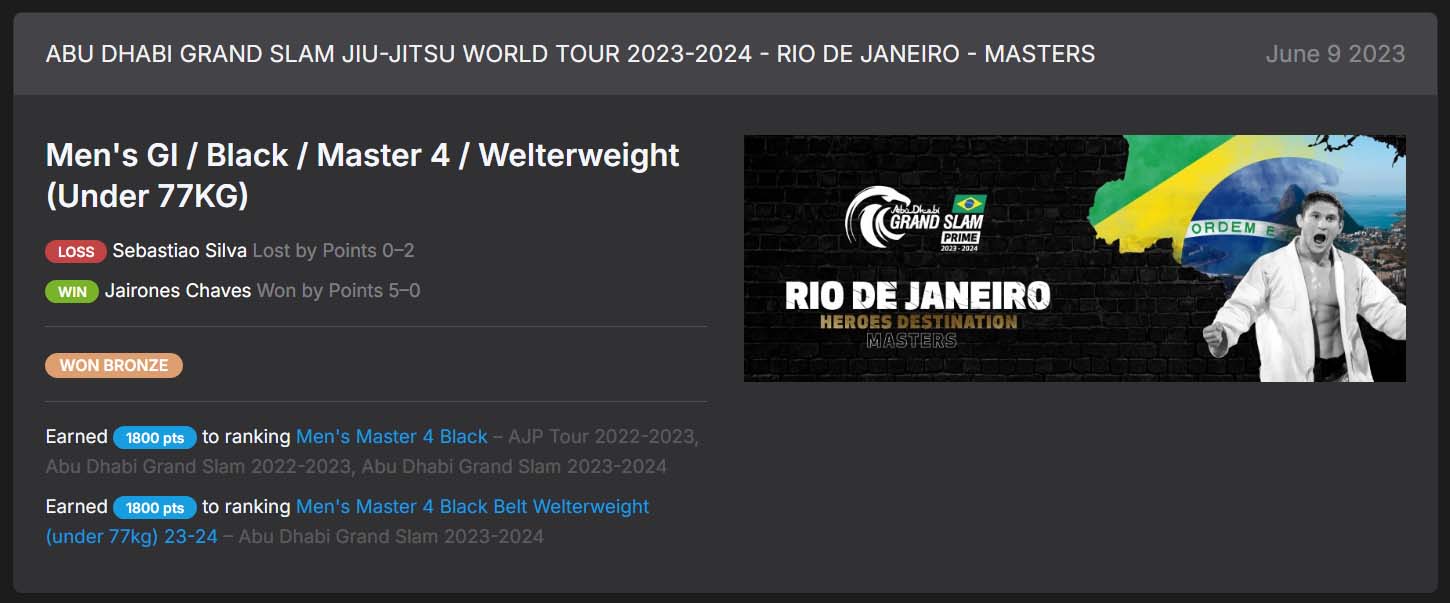
We’ve reached out to the UAEJJF for comment. This article will be updated if they provide one.
Franca competed under Confederação Brasileira de Jiu-Jitsu Esportivo (CBJJE) in 2025.
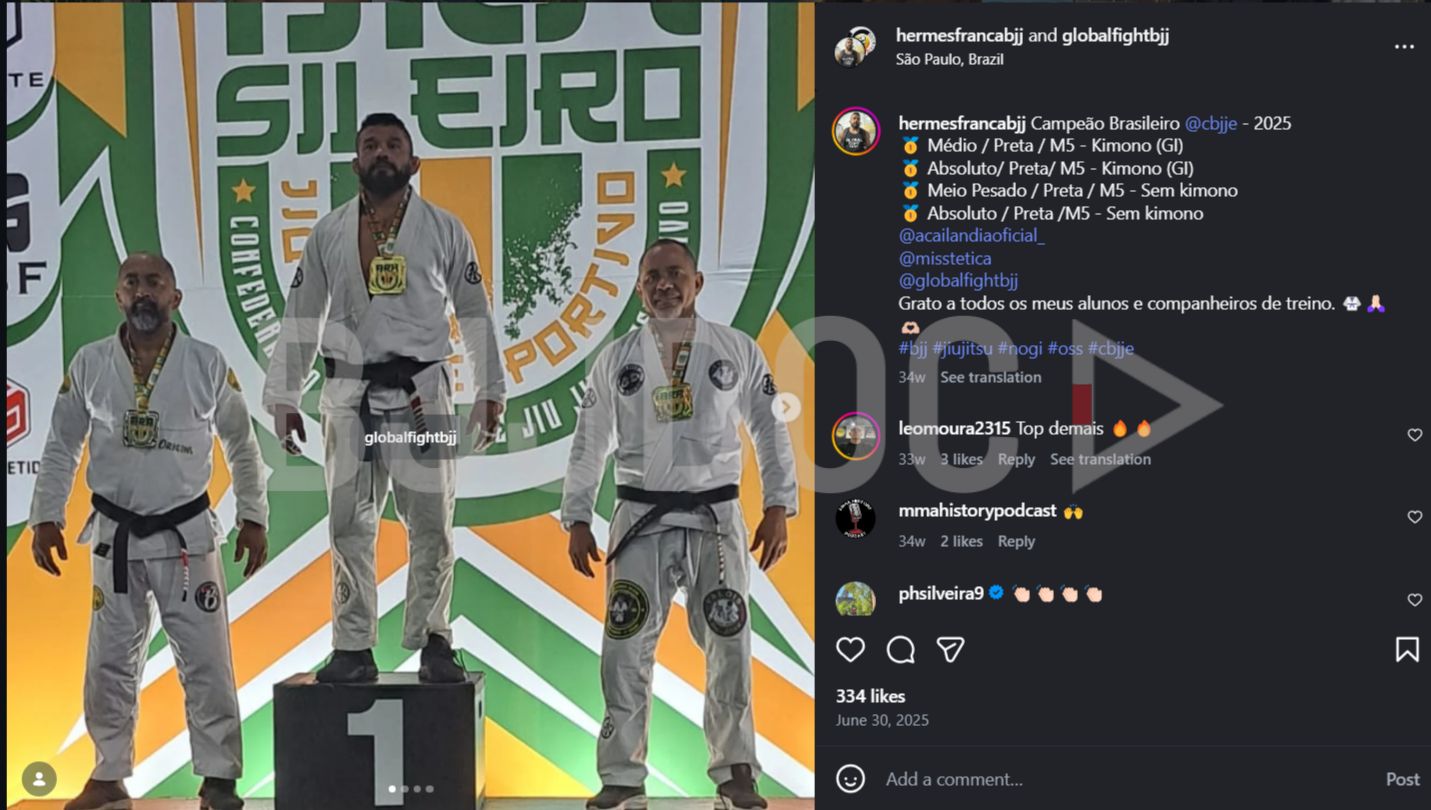
Franca now teaches in Brazil under the Instagram handle Hermes Franca BJJ. He expressed remorse for his past actions during the interview.
“I did a lot of mistakes in my life. If I did a lot of mistakes for someone that listen to the radio, the interview right now, my apology, you know, forgive me.”
His About US page makes no mention of his conviction.

He’s competed professionally as far back as last month.

Brazilian jiu-jitsu frequently speaks about honor, discipline, and character. Cases like this force the sport to confront whether those values apply equally when reputation and medals are involved.
Regardless of Franca’s accomplishments, the gravity of his conviction should compel major federations and promotions to clarify their safeguarding standards. In a sport where children and teenagers routinely train alongside adults, silence is not a neutral position.