

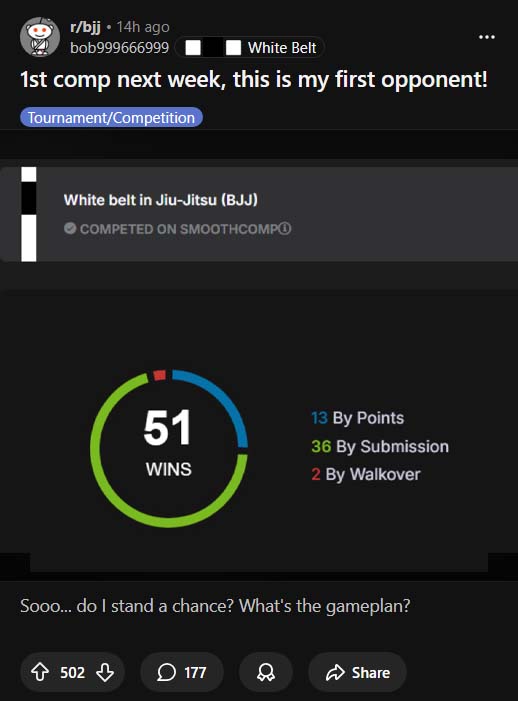
A first-time competitor’s Reddit post goes viral after discovering his upcoming opponent has 36 submission wins, and still calls himself a white belt. It’s the kind of thing that makes a beginner want to quit before they’ve even started.
A Reddit user posting to bob999666999 shared what he thought would be a fun milestone post ahead of his very first Brazilian jiu-jitsu competition. Instead, he accidentally ignited one of the sport’s most persistent debates. The post read simply:
“1st comp next week, this is my first opponent!”
accompanied by a screenshot from Smoothcomp showing a competitor with 51 wins, 36 of them by submission, 13 by points, and 2 by walkover. The belt listed, white. The post racked up over 500 upvotes and 177 comments, with the community torn between sympathy, dark humor, and genuine outrage. The first-timer’s closing question summed it up:
“Sooo… do I stand a chance? What’s the gameplan?”
The short answer, most agreed, was probably not.
This is not a new conversation in BJJ. Just last year, a similar post went viral after a screenshot surfaced showing a blue belt with 218 wins, 130 by submission, accumulated over three years, prompting widespread debate about whether any governing body should be able to compel a promotion.
The core issue is that Brazilian jiu-jitsu, unlike most combat sports, has no universal standard for belt promotion. There is no exam, no single governing federation with enforcement power, no mandatory timeline. Promotion is entirely at the discretion of the student’s instructor, which means the definition of a white belt can vary wildly from one gym to another, one country to another, one philosophy to another. And that creates the conditions for exactly what Bob walked into.
The most commonly accepted informal standard in BJJ circles is that a white belt is someone who is still learning the fundamentals, and the rough benchmark often cited is that a white belt should be able to handle an untrained person. That’s the floor. The minimum. The baseline expectation before you start moving up. By that measure, someone with 36 submission wins in competition, against other people who presumably also train, cleared that bar a long time ago.
Rickson Gracie has publicly articulated his own standards for what constitutes readiness for blue belt, standards far more demanding than simple attendance or time on the mat. His view, shared by many old-school practitioners, is that a belt should represent a genuine and functional level of ability, not just time served. But the reality on the ground in modern BJJ often looks very different.
Jon Jones, considered by most to be the greatest mixed martial artist of all time, is still a brown belt under his coach Tussa Alencar. The reason isn’t that Jones can’t compete. It’s that Alencar reportedly won’t promote him until he demonstrates sufficient time and commitment in the gi.
That’s a principled stance, and it’s one that many coaches quietly admire. But it also illustrates how belt rank in BJJ is less a measure of ability and more a reflection of the relationship between a student and a specific instructor operating under a specific philosophy.
Part of what allows records like 51-0 to accumulate at white belt is simply how modern competitions are structured. Round-robin formats, double divisions, absolute categories, and the sheer volume of local and regional events mean a dedicated competitor can stack dozens of matches in a single calendar year.
A committed white belt who travels to competitions every few weeks can accumulate a professional-looking record before their instructor has even considered them for promotion. That’s not necessarily malicious. Some people genuinely just love competing and their instructor hasn’t promoted them yet. But from the perspective of the first-time competitor standing across the mat from someone with 51 wins, the distinction doesn’t much matter.
That’s the question Bob was really asking, even if he phrased it as “do I stand a chance?” The uncomfortable truth is that in a sport with no unified standards, the beginner absorbs most of the risk. They sign up in good faith, show up to their first tournament, and can find themselves matched against someone who has more competition experience. They get submitted, they feel discouraged, and some of them don’t come back.
The broader BJJ community has floated solutions, skill-based ranking within divisions, mandatory promotion after a certain number of wins, independent competitive records tied to belt movement, but none have been adopted universally. The sport’s decentralized nature, the very thing that gives it so much cultural richness and regional variation, also makes systemic reform nearly impossible to implement.
For now, the best advice the Reddit thread could offer Bob was to treat the match as a learning experience, stay defensive, and not take the result personally. Which is fair advice, but it probably wasn’t what he was hoping to hear a week before his very first competition.