
Claudia Gadelha recent appearance on the Mundo de Luta podcast offered the most transparent look yet at how UFC BJJ operates as a business and what it intends to become.
What emerged was a picture of a well-funded organization making genuine inroads into athlete compensation while borrowing from a playbook that has historically not worked in athletes’ favor.
Gadelha stated that exclusive UFC BJJ athletes competing four times a year are earning between 500,000 and 800,000 Brazilian reais annually. At current exchange rates, that translates to roughly $97,000 to $155,000 USD real money in a sport where most elite jiu-jitsu athletes have historically earned far less or nothing at all.
“Now there are athletes earning 500,000 reais to do a jiu-jitsu contest. It’s incredible.”
By grappling sport standards, it genuinely is. The vast majority of elite jiu-jitsu athletes fund their competitive careers through teaching, seminars, and instructional sales rather than competition.
UFC BJJ Exclusive Contract Earnings Breakdown
Reported Annual Range: $97,000 – $155,000 USD
Assumption: 4 matches per year, all won by submission (double purse), no bonuses included.
| Scenario | Annual Total | Per Match (4x) | Implied Base Purse | Submission Win Pay |
|---|---|---|---|---|
| Low End | $97,000 | $24,250 | $12,125 | $24,250 |
| High End | $155,000 | $38,750 | $19,375 | $38,750 |
How The Math Works
If submission wins effectively double the base purse, then:
- Low End Base Purse: $12,125 per match
- High End Base Purse: $19,375 per match
Winning by submission 4 times:
- $12,125 × 2 = $24,250 per match → 4 matches = $97,000
- $19,375 × 2 = $38,750 per match → 4 matches = $155,000
What This Means
Under this interpretation, the reported range assumes athletes maximize earnings by finishing all four contracted bouts by submission.
If an athlete wins without a submission, loses, or competes fewer than four times, the annual income would fall below this range.
Performance bonuses, sponsorships, and undisclosed incentives are not included in this breakdown.
UFC BJJ purses have a more predatory split than even MMA ones. In MMA, your paycheck is split into show money and win money and you can get a bonus on top of that. In UFC BJJ you get Show Money and Submission Money. If you win but don’t submit your opponent you’re effectively leaving half the money on the table. Using Clauda Gadelha’s own math that means that if they do offer you 4 matches in a year – you will only make around $65,000.
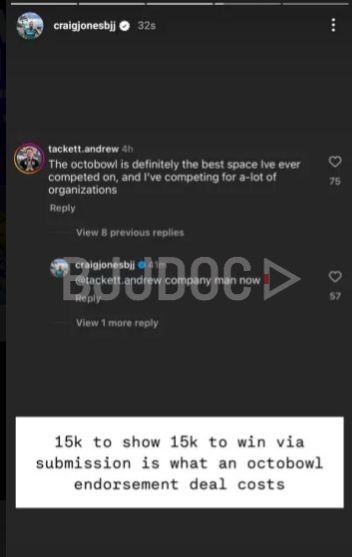
This is on par with what Craig Jones claimed when Tacketts were signed in 2025. The figure that floated then was $15,000 to show, $15,000 to win. Andrew Tackett has since also said he’s receiving some sort of a stipend from the UFC that allows him to dedicate himself fulltime to the sport.
Further, the langauge on the podcast indicates that this is applied mainly to their 10 exclusive athletes. There’s been no confrimation about what the rest makes. But given that UFC won’t even feed the non exclusive athletes at the UFC Performance Institute, it’s probably nothing to write home about.
Big part of Gadelha’s pitch is comping tickets for athletes to go to UFC Events. That alone is a pitch that costs UFC nothing and won’t do anything for majority of talent.
Gadelha also confirmed that UFC BJJ is developing its own instructional platform and a global seminar program. The goal, she explained, is to create multiple revenue streams for contracted athletes beyond competition pay and to bring UFC’s marketing infrastructure to bear on content monetization. This announcement deserves context.
BJJ Fanatics currently holds what amounts to a near-monopoly on the paying BJJ audience. Their email list represents the overwhelming majority of customers who have ever purchased instructional content, which is why most top athletes release on their network regardless of personal platform preferences.
The biggest sellers — John Danaher, Craig Jones, Gordon Ryan — move enormous volume through Fanatics.
Independent operations like Roger Gracie and Lachlan Giles exist successfully, and Keenan Cornelius Jiu-Jitsu X made headlines as a concept, though its current trajectory is uncertain.
Gordon Ryan in particular has been vocal about his earnings, posting receipts that make the commercial potential of top-tier instructional content impossible to ignore. UFC has clearly done that math. Entering the instructional space with an established brand, global distribution infrastructure, and exclusive access to top athletes is not an experiment; it is a calculated market entry.
Gadelha framed exclusivity as an investment partnership rather than a restriction.
“Our exclusivity contract is not to control the athlete, because we invest in the athlete.”
More structurally, UFC contracts contained tolling provisions meaning the contract clock paused any time an athlete was “unable or unwilling” to compete, including when turning down an offer they considered unfair. This mechanism was central to the $375 million antitrust class action settlement finalized in 2025, which found that such provisions had suppressed athlete pay across the sport for years.
There is no reason to assume UFC BJJ’s exclusivity model is identical to MMA contracts, but there is also no reason to assume it is categorically different. The same organization, the same legal architecture, the same incentives. Four contests per year sounds like an active schedule until you consider what happens when an athlete wants to renegotiate, misses time due to injury, or publicly expresses interest in competing elsewhere. Add to that the fact there’s only 10 events per year.
The contractual tools available to a large organization dealing with a relatively powerless individual athlete tend to favor the organization.
None of this means UFC BJJ’s investment in the sport is worthless or cynical in its entirety. Consistent athlete pay, some exposure, and professional infrastructure are things jiu-jitsu has lacked. If UFC BJJ raises the floor for what competitive athletes can earn, that matters.
But the instructional market announcement should be read clearly for what it is: a large corporation identifying a monetization model that independent athletes and a dominant platform have already proven works, and positioning itself to capture a share of it — ideally with exclusive access to top talent and UFC’s marketing scale behind it. That is not a partnership with the existing ecosystem. It is a competitive entry into it, backed by resources most independent operators cannot match.
Gadelha’s transparency on the podcast was genuinely useful. The numbers are real, the ambitions are clear, and the pitch is compelling enough that some athletes will sign. The question is what the fine print looks like two or three years in, when an athlete wants out, wants to renegotiate, or wants to post an instructional independently.
The history of athletes trusting large organizations to honor the spirit of a partnership rather than the letter of a contract is not an encouraging one.