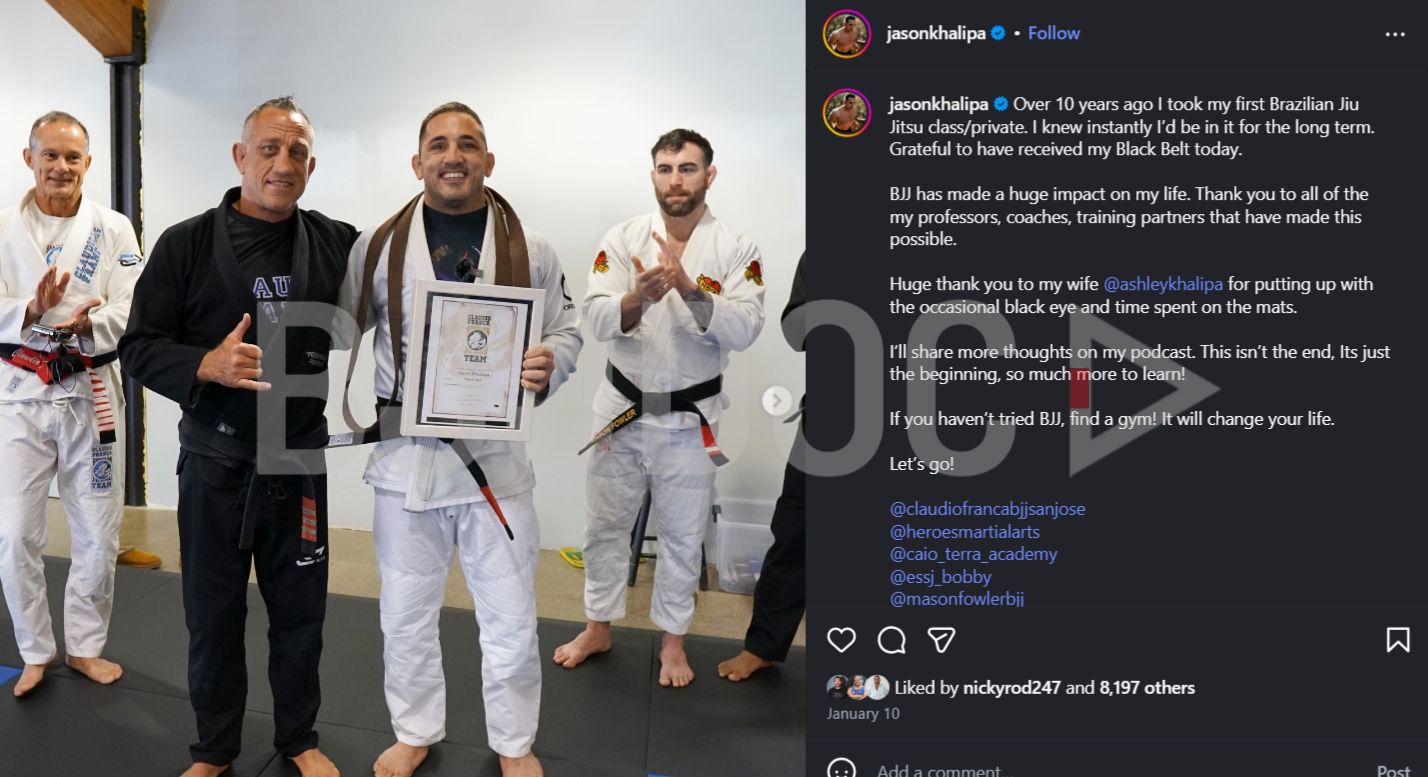

When Jason Khalipa walked into his first Brazilian Jiu-Jitsu class over a decade ago, he knew immediately that the grappling art would become a permanent part of his life. This past weekend, the 2008 CrossFit Games champion officially received his black belt, marking the culmination of ten years of consistent training on the mats.
“Grateful to have received my Black Belt today. BJJ has made a huge impact on my life. Thank you to all of my professors, coaches, training partners that have made this possible,”
Khalipa shared on social media.
The achievement represents a significant milestone for an athlete already known for his accomplishments in functional fitness. Khalipa competed at the CrossFit Games eight times, establishing himself as one of the sport’s most recognizable figures. Yet his journey in jiu-jitsu followed a different timeline, one measured not in podium finishes but in steady incremental progress.
Khalipa first encountered Brazilian Jiu-Jitsu in 2009, though the timing wasn’t right for him to commit. Years later, during a particularly challenging period when his daughter was dealing with illness, the grappling art re-entered his life at what he describes as the perfect moment. He needed something that demanded complete focus and forced him to be fully present.
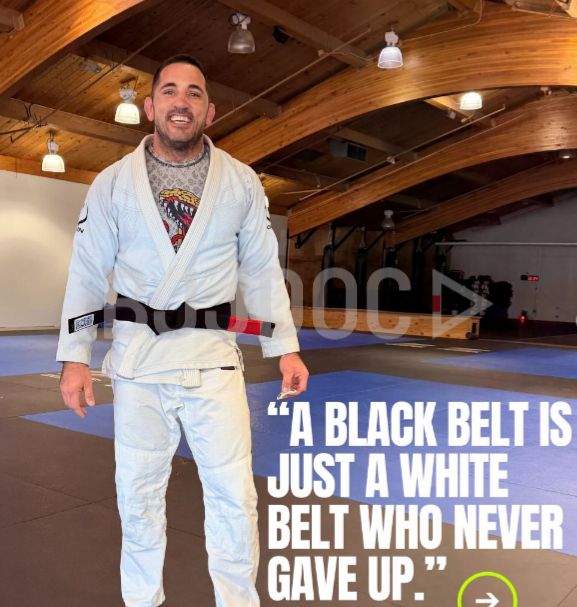
On that first day back, Khalipa asked his professor a simple question: What does it actually take to earn a black belt? After walking through the criteria, expectations, and time commitment, his professor offered a response that would stay with him throughout the entire journey.
“A Black Belt is just a White Belt who never gave up,”
the professor told him.
That philosophy became Khalipa’s guiding principle. BJJ competitor Mason Fowler, who attended the promotion ceremony, later shared Khalipa’s reflections in a newsletter that resonated with many readers. In those thoughts, Khalipa emphasized that reaching black belt felt
more like starting over than finishing,
There’s nothing special about my techniques, my knowledge, or my abilities. I’m not more talented than the next guy. I’m just someone who kept showing up for ten years and didn’t quit,
Khalipa wrote.
Throughout his jiu-jitsu journey, Khalipa has become an influential voice connecting the worlds of strength training and grappling. As someone who trained at Claudio Franca BJJ San Jose, Heroes Martial Arts, and Caio Terra Academy, working with coaches, he developed unique insights into how CrossFit principles can enhance performance on the mats.
During previous conversations about training methodology, Khalipa has advocated for what he calls a gap analysis approach. For grapplers who possess solid technique but lack physical attributes, he suggests that focused strength and conditioning work might produce better overall improvement than additional mat time alone.
“I’ve been training in jiu-jitsu for a while now, and I recognize that there’s a need for strength and conditioning training. I think CrossFit, I think getting into the gym can really help you. You got to use the right movements at the right time with the right effort, and I think if you do that you’re gonna see your game on the mat just go through the roof,”
Khalipa explained during a visit to his gym facility.
One area where Khalipa challenges conventional wisdom involves workout duration. Rather than lengthy training sessions, he recommends brief focused work periods that mirror the intensity of grappling rounds.
“Most people think when they go work out, they need to work out for an hour, 90 minutes, whatever. Have you rolled for six minutes on the mat? You’re exhausted when you’re done. So workouts don’t have to be super long. They just have to be at your best effort, at a high intensity, and have the movements that are gonna provide the best bang for your buck. And that’s somewhere in between 10 to 20 minute workouts,”
he said.
Khalipa also draws parallels between technical precision in both disciplines.
“In jiu-jitsu, technique is everything, right? It’s the difference between getting out of a triangle or not getting out of it. And I think in fitness or in CrossFit it’s the same. If your positions are wrong, not only are you not going to be as efficient, but even more importantly you could potentially get hurt,”
he noted.
For the CrossFit champion, training serves a purpose beyond athletic achievement. He views martial arts as essential for mental development and personal growth. The controlled challenges of training, he believes, build resilience that transfers to all areas of life, from family to business.
In his social media post announcing the promotion, Khalipa expressed gratitude to his wife Ashley
“for putting up with the occasional black eye and time spent on the mats,”
and he also promised to share more detailed thoughts on this while making clear that earning the black belt represents a beginning rather than an endpoint.
“This isn’t the end, It’s just the beginning, so much “more to learn! If you haven’t tried BJJ, find a gym! It will change your life,
Khalipa wrote.
Success in any meaningful pursuit requires the same fundamental approach that earned him his black belt: simply refusing to quit, day after day, year after year, until you reach the goal that once seemed impossibly distant.