
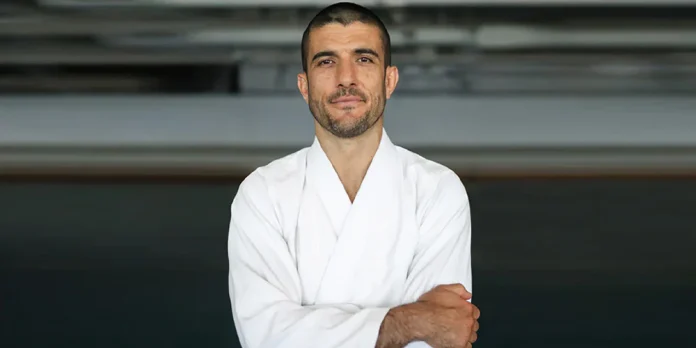
Attorney and elite grappler Paul Ardila recently addressed the controversial case involving Rener Gracie‘s testimony against a BJJ instructor.
When word spread that Rener Gracie took the witness stand against a jiu-jitsu instructor in a major injury case, the reaction across academies was swift and polarized. The verdict has ballooned past $56 million, and the fallout forced practitioners everywhere to confront uncomfortable questions about instructor liability, what we owe beginners who walk through the door, and whether a Gracie testifying against another coach crosses some unwritten line.
The incident happened in November 2018 at Del Mar Jiu Jitsu Club. Jack Greener walked in for what was reportedly his first trial class. He left with a fractured neck and spinal cord damage after a sparring session with black belt instructor Francisco Iturralde, who worked through a sequence on the novice while he was turtled up.
United States Fire Insurance Company turned down a $1 million settlement offer before trial,, the full policy limit. The jury came back with $46.5 million. Interest and costs pushed the total past $56 million, leaving the insurer on the hook for massive excess exposure well beyond what they could have paid to make the problem disappear.
Rener Gracie testified for the plaintiff. Clark Gracie testified for the defense. Two Gracies. Opposite sides. The family that built Brazilian jiu-jitsu now publicly disagreeing about what counts as acceptable instruction.
Rener vs. Clark: Frame by Frame
Court records show Rener Gracie walked the jury through video footage frame by frame. His conclusion: the grip gave Iturralde no real control over Greener’s head or neck.
“I had never seen that move performed or taught in the manner Iturralde used,”
he testified.
“An expert of Iturralde’s level would know that by the arm being bound the way it is, and the head not being controlled in any way, any forward pressure or momentum would be directed toward the subject’s head.”
Rener also pushed back on the idea that hard sparring does much for brand-new students.
“You rarely remember what just happened to you,”
he said about getting worked in live rolls. He went further, suggesting that if this kind of conduct became standard, it would poison the well for recruiting.
“If Iturralde’s conduct was acceptable conduct by an expert black belt instructor in the industry of Brazilian jiu jitsu, it would have a negative long-term effect on attracting people to this art.”
Clark Gracie saw it differently. He told the court the grip and positioning looked fine to him, reasonably safe, nothing improper. He’d seen the move plenty of times. Sparring, he argued, gives students real-time experience defending and anticipating techniques.
Then came cross-examination. Clark admitted there were technical limits to controlling the head with that grip. He also conceded that Iturralde could have bailed on the maneuver earlier. Those admissions handed the plaintiff exactly what they needed: evidence the injury wasn’t inevitable.
Ardila’s Gut Check
Ardila didn’t hide his first reaction when he heard Rener was testifying against another instructor. He told Grappler’s perspective podcast:
“Initially, like everyone else, I think I had a very visceral reaction like, ‘Yo, man, why are you testifying against your own?’ You know what I mean?”
That sentiment echoed through group chats and locker rooms. Testifying against your own feels like breaking rank, especially when it’s a Gracie doing it.
But after digging into what actually happened, Ardila’s position shifted. This wasn’t about loyalty to the tribe. It was about what black belts owe white belts.
“The standard of care for someone who’s a black belt is or should be higher. Like you should be held to a higher standard because not only are you a black belt, but you’re also the coach, man. You know what I’m saying? Like why are you trying wild moves?”
Trial testimony showed Iturralde knew things were going sideways. He acknowledged that
“Something bad was going to happen”
but kept going anyway.
Ardila framed it with a hypothetical that strips away the complexity.
“What if it wasn’t that move? What if the coach tried to do a scissor leg takedown and just snap the guy’s ACL, right? I think at that point, where’s like a move that is more clear like you know, you shouldn’t do that,”
he said. Some techniques have no business being tested on day-one students.
“A guy who’s just trying to figure out what jiu-jitsu is and you’re doing like these crazy moves, you know? You messed up. It is what it is, right?”
Ardila’s own experience
Ardila shared a story from his own experience that drives home why beginners can’t be expected to react like practitioners.
“I put in her fireman (carry). I’m like, ‘Okay, I’m going to roll you over now.’ And I try to roll her over. And she panicked and put her neck up. So, she face planted straight into the mat,”
he recalled.
“When you’re just starting out like what is common sense to us it doesn’t apply to them you know what I mean,”
he said.
That’s the gap. What feels obvious after years on the mats, tuck your chin, don’t post with your face, protect your neck, doesn’t exist yet for someone who just signed the waiver.
What the Court Said
Greener eventually regained some function after extensive treatment, though the injury left permanent damage. The jury decided Iturralde unreasonably amped up the risk beyond what you’d expect from BJJ sparring.
The appellate judges made a point of narrowing their ruling so it wouldn’t nuke all hands-on instruction.
“We emphasize the narrowness of our holding, which applies option 2 of CACI No. 471 to combat or grappling sports when an instructor engages in the activity while not providing any demonstration or instruction.”
They drew a line between teaching and just rolling.
“While sparring with Greener during a Brazilian jiu jitsu class, Iturralde gave no demonstration or active instruction. Instead, he acted more like a student coparticipant than an instructor when he immobilized and executed a series of maneuvers on Greener.”
That distinction matters. If you’re drilling a technique and walking students through it step by step, different standards apply. But if you’re treating a first-timer like a sparring partner and working your favorite back take while they have no idea what’s happening, that’s where the exposure lives.
The Response
A dissenting judge worried this would scare instructors away from realistic training.
“If an ordinary negligence-based standard applies to hands-on instruction in an inherently dangerous sport, the scope of instruction in those sports will suffer.”
The majority replied by focusing on what Iturralde actually did.
“The risk an instructor will perform a maneuver on a student after immobilizing the student and knowing it will injure the student is not an inherent risk of BJJ sparring.”
Knowing something bad is about to happen and doing it anyway isn’t teaching. It’s recklessness.