

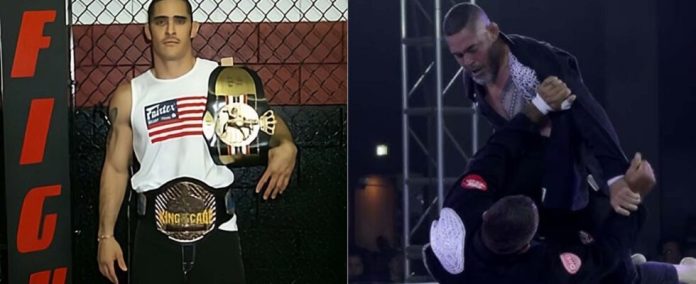
Hawaiian MMA star Ron Jhun had an unconventional approach to earning his jiu-jitsu belts that perfectly captured the spirit of the era. His story, shared on the MMA History Podcast, reveals a time when the martial arts hierarchy was still being figured out and tradition sometimes took a backseat to pragmatism.
Jhun’s journey into jiu-jitsu competition began without formal instruction. Training primarily from video tapes with his brother in law at the Solid Rock Grappling Room, Jhun decided to test his skills at one of Relson Gracie’s jiu-jitsu tournaments in Hawaii. When asked about his instructor at Casey Martial Arts where he purchased his gi, Jhun gave an answer that would become legendary in local MMA circles.
“Who’s your instructor? I know my instructor. How you get your belt? I bought it. I bought it from Casey Martial Arts.”
Despite his unorthodox credentialing, Jhun proceeded to win both his weight class and the absolute division at that tournament.
His performance spoke louder than any lineage certificate could. Emboldened by his success, Jhun returned to Casey Martial Arts and promoted himself to blue belt before the next tournament, purchasing the appropriately colored belt for $9.99.
When the same tournament organizer spotted Jhun signing up with his new blue belt, the confrontation was inevitable.
“How you get your blue belt? It was on sale at Casey Martial Arts for $9.99.”
Gracie was not amused.
“He was mad. Oh, no. You don’t do that. He sent his guys after me. I think the first two matches were from Gracie Jiu-Jitsu. Yeah. It’s like full belt, four stripers.”
When asked how many stripes he had on his blue belt, Jhun remained characteristically unfazed.
“I was like, oh, I don’t know. Just blue belt. I don’t know. I got to see how I do in this tournament. I’ll give myself a stripe after this tournament. You know, if I do good, give me a match or two. I’ll tell you how many stripes are on this thing.”
The story eventually reached John Lewis, one of first 12 non Brazilian BJJ Black belts,. Lewis invited Jhun to train at his gym and asked about the blue belt situation. After rolling with Jhun, Lewis gave his verdict.
“You (are) a legit blue belt. If anybody asks, just tell them John Lewis gave you a blue belt.”
Jhun’s approach reflected the reality of early 1990s mixed martial arts in Hawaii, where traditional martial arts politics often clashed with the practical demands of competition. The jiu-jitsu community was fractured, with gym loyalty creating complicated barriers.
“The jiu-jitsu community was real complicated. If you trained at this gym you cannot train with this person or you cannot.”