

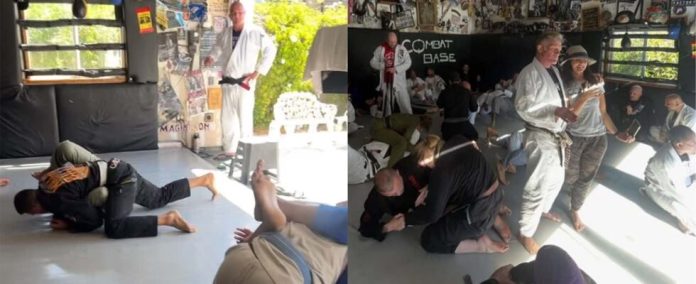
The legendary garage dojo that helped shape American jiu-jitsu culture has rolled its final round. Combat Base, operating out of Chris Haueter’s Redondo Beach garage for 21 years, held its last open mat on January 18, marking the end of an era for one of Southern California’s most respected grassroots training spaces.
The closure follows the sale of the property on Avenue D after the October passing of Judith Haueter, Chris’s mother and the home’s owner. For more than two decades, the space served as an unconventional sanctuary where some of the art’s most dedicated practitioners gathered to train, share techniques, and preserve the raw essence of jiu-jitsu.
“When jiu-jitsu first landed in America, it landed in Hermosa Beach,” said Eddie Cairns, who began training under Haueter in 2008 as per local news. “We usually cram in pretty tight in the garage. It’s a backyard D.I.Y. martial arts space. Super unconventional which is kind of why it’s so iconic.”
Haueter, one of the first 12 Americans ever awarded a jiu-jitsu black belt, began his training in 1988 and earned his black belt in 1996. He first laid mats in a small one-car garage at the front of the property in 2005. By 2007, after his wife Melissa suggested converting the larger three-car garage previously used for automotive work, the space expanded to accommodate six pairs training simultaneously.
The decision to close wasn’t made lightly. Economic realities made continuation impossible, even as the surrounding neighborhood transformed dramatically.
“We are here in Redondo Beach. Like most areas along a coast, there is a limited resource called the beach. My father, when he purchased his first home in Manhattan Beach for like $56,000, knew that eventually they are going to run out of beach land and that beach land is valuable,” Haueter explained on his podcast.
The area’s transformation has been striking. Haueter recalls when nearby properties housed chop shops and underground operations, when motorcycle riders would park on lawns. Today, homes sell for $3 million.
“I have watched this neighborhood gentrify. Eventually I knew we would either, if we could hold on to this thing, we would have a good nest egg, or we would be gentrified out.”
The couple explored opening a commercial space but faced daunting financial obstacles. Melissa Haueter, a fourth-degree black belt who manages their online Combat Base Club platform, outlined the mathematics:
“Let us just say we are going to let go of a bunch of the other stuff Chris is doing so we can open up a school. So now we are going to pay six grand a month in rent plus lose four or $5,000 a month in income. So now we are actually in the hole like $11,000 instead of just six grand a month.”
“We cannot afford to do that because we cannot even afford to keep this space. Because if we could afford to go in the hole $5,000 a month, we would be able to afford to keep this space,” she added.
The garage operated on a fundamentally different model than commercial academies. Without the burden of commercial rent, Combat Base maintained an intimate atmosphere with roughly 20 regular practitioners, mostly black belts, rather than the 200-student enrollment typical commercial operations require to survive.
“At this point in time, I feel like I do not have the desire to pay to go to work. I get paid to work and I will not pay to go to work,” Haueter said.
Training sessions ran three times weekly on Tuesday, Thursday, and Sunday, drawing locals, travelers, and seasoned practitioners who valued the space’s authentic, uncommercial character. The invite-only environment centered on open mats and cultural exchange rather than structured curriculum or belt progression.
“People were invited to come over and practice with us,” Melissa said. “We’re using jiu-jitsu to help better people’s lives.”
That philosophy created what Melissa describes as a uniquely safe training environment.
“You cannot say that every mat room that you walk into, every gym that you walk into, that you are 100% confident that the people that you train with are going to take care of you. But I could say that about my people here.”
The space hosted seminars with notable instructors including Clark Gracie, Jeff Glover, and Renato Laranja, attracting practitioners from around the world seeking authentic training experiences.
“There’s different styles, and in the garage, there was constantly people coming from around the world,” Cairns said.
For some, Combat Base provided more than technical instruction. Wesley Nash, who grew up just two houses away, discovered the garage at a critical juncture. After being expelled from Redondo Union High School at 15, he trained intensely at Combat Base while working toward reinstatement. The discipline he developed there helped him graduate with his class, earn a third-degree black belt, and eventually become both an L.A. County emergency responder and a licensed pilot.
“It’s unfortunate it’s closing,” Nash said during the final gathering. “But, like my buddy said, ‘nothing lasts forever.’ This place means a lot to me. It got me out of a lot of trouble. When I found this place I was in a lot of trouble.”
Cairns echoed the sentiment about the space’s deeper impact. “I’m a lifelong resident. The garage was important to the community. A lot of people were kind of saved by Melissa and Chris’s hospitality.”
Despite the emotional weight of closing, Haueter maintains a philosophical perspective. “I know that all things come to an end. Through all that stuff comes new growth. I see this as an opportunity rather than a liability.”
The Combat Base Club will continue operating independently of any physical location, with Haueter maintaining his teaching schedule and seminar circuit. Meanwhile, longtime participant Kyle Thompson is preparing to open a replacement open-mat space in a former barber shop on Torrance Boulevard, ensuring the community forged in that garage has somewhere to continue training together.
Combat Base represented something increasingly rare: a training environment built on authentic relationships, shared passion, and the belief that jiu-jitsu’s true value lies in how it transforms lives rather than how many memberships it sells.