

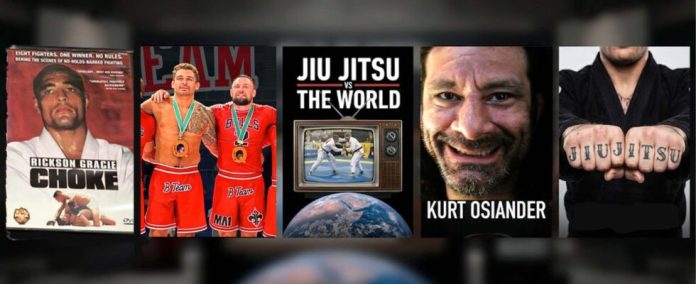
Brazilian Jiu-Jitsu occupies a unique space in the sports world. While it has grown significantly since the early UFC days, it remains a niche discipline with a fiercely dedicated following. Unlike mainstream sports with endless media coverage, quality BJJ documentaries are rare treasures. These films aren’t just entertainment for practitioners; they’re records of the culture surrounding a unqiue martial art. For grapplers, these documentaries offer something invaluable: a chance to see their passion reflected back through thoughtful filmmaking. They document the personalities who have shaped jiu-jitsu into what it is today.
Choke
Few documentaries capture a sport at such a pivotal moment. This 1999 film transports viewers to the 1995 Vale Tudo tournament in Japan, when mixed martial arts existed in its rawest, most unregulated form. The filmmakers secured remarkable access to four MMA stars, including Rickson Gracie, following them through preparation and into the ring itself.
What emerges is less about glorifying combat and more about understanding it. The camera captures a wrestler’s tears after defeat, the collective anticipation of Japanese crowds, and the technical mastery that allowed smaller competitors to overcome seemingly insurmountable size disadvantages. The 5’7″, 150 lbs (68 kg) Yuki Nakai’s repeated victories over much larger opponents demonstrate the art’s core principles in action.
The film’s treatment of Rickson Gracie particularly stands out. Rather than presenting an untouchable legend, it reveals a disciplined practitioner whose breathing techniques and transition work elevated his game. His three consecutive submissions throughout the tournament become demonstrations of applied philosophy rather than mere athletic dominance.
The original documentary has been taken off youtube but is still avilable to watch elsewhere.
ROLL: Jiu-Jitsu in SoCal
This documentary focuses on the oral history of Brazilian Jiu-Jitsu’s arrival in America. Through interviews with the “Dirty Dozen” (the first Americans who trained directly under the Gracie family in the late 1970s and early 1980s) the film reconstructs an era when the art was virtually unknown outside Brazil.
Richard Bressler, Rorion Gracie‘s first regular student beginning in 1979, describes $10 half-hour private lessons in garages, long before mainstream recognition or commercial academies. The documentary explores the famous Gracie Challenge matches through rare footage and firsthand accounts, showing how these controversial encounters established the art’s credibility among skeptics.
The film also examines Southern California’s evolution into the global epicenter of jiu-jitsu, surpassing even Brazil as the destination for elite practitioners. World champions like Leo Vieira and Claudio Calasans explain how California’s weather, tournament proximity, economic opportunities, and concentration of training partners transformed it into the art’s new “motherland.”
Perhaps most interesting is the film’s exploration of tension between old-school practitioners who value self-defense applications and those embracing modern sport competition. This ongoing identity negotiation reveals a community still defining itself.
The B-Team: The Greatest Grappling Team of All-Time
This documentary succeeds by showing what most competition films avoid: the unglamorous reality behind elite performance. Following Craig Jones, Nicky Rod, Nicky Ryan, Jay Rodriguez, and Jozef Chen to Tokyo for the Quintet team grappling event, the film captures everything from cultural misadventures to strategic frustrations.
The contrast between American personalities and Japanese culture creates unexpected humor and insight. But the documentary’s real strength lies in its storytelling. The team’s confident pre-competition swagger gradually shifts to reality, with Craig Jones emerging as an unlikely savior for a group that expected total dominance.
The film balances spectacular Japanese production values with intimate locker room moments, creating something that transcends typical sports competition coverage. It’s a portrait of high-level athletes navigating unfamiliar territory both culturally and competitively. It’s even more interesting to watch given everything that’s happened to the team since.
Jiu-Jitsu VS The World
This film takes a profoundly humanistic approach to exploring Brazilian Jiu-Jitsu as life philosophy rather than mere sport. Through testimonials from practitioners across all demographics (children, elderly students, law enforcement officers, recovering individuals, and professional musicians) the documentary weaves together diverse experiences united by a common thread.
What distinguishes this film is its exploration of jiu-jitsu as transformative force. Practitioners share emotional accounts of how the art helped them through personal crises, emphasizing character building, humility and resilience over competitive achievement. The documentary addresses the unique bonds formed through physical training, where the intensity of the mat creates friendships deeper than conventional social interactions.
By featuring voices from different academies, lineages, and backgrounds without promoting any single school or champion, the film presents a collective portrait of a global community. It serves as both cultural anthropology and inspirational narrative, showing how shared struggle and growth connect people across vast differences.
Kurt Osiander: My Goal Is Not Just To Teach You JiuJitsu
Stuart Cooper’s documentary about Kurt Osiander breaks from conventional martial arts film formats by presenting an unfiltered portrait that extends far beyond training. Rather than focusing on technique demonstrations, the film captures Osiander’s life in San Francisco across multiple dimensions (learning tattoo artistry at Seven Sons Tattoo, his Sunday firearms practice, and his approach to every discipline with the same dedication he brings to jiu-jitsu).
The raw footage reveals an instructor who refuses to sanitize his methods or language for cameras. Intimate moments (picking up students from school, meticulously cleaning his academy, the visible toll of decades on the mats through damaged hands) create a complete picture of what running an academy actually entails.
Osiander’s philosophy centers on using jiu-jitsu as a vehicle for developing better humans rather than just teaching techniques. His academy culture emphasizes aggressive, realistic training that builds genuine capability. The film also documents his “Move of the Week” videos, a brief MMA career undertaken at 47, and his vision for events combining competitions with tattoo conventions and live music.
This documentary succeeds because it presents jiu-jitsu not as isolated sport but as one component of an authentic, complex life philosophy.